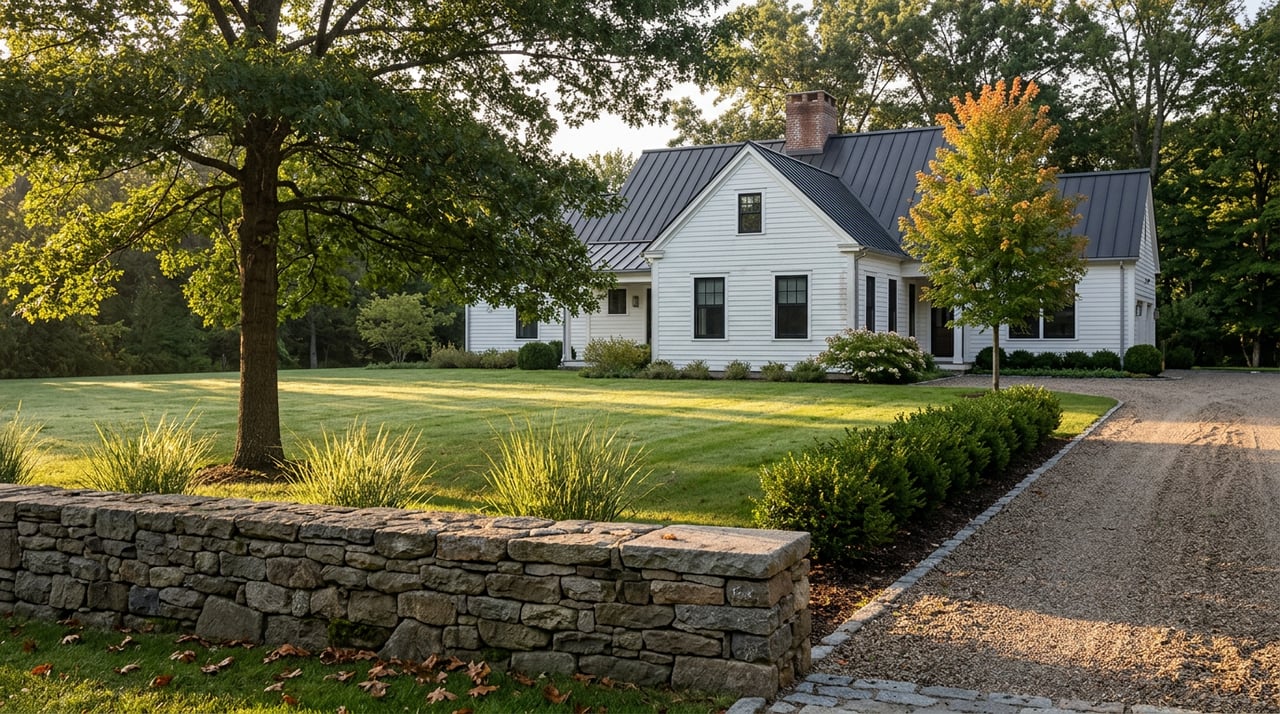
On November 3, 2025, Dover's Planning Board opened a joint public hearing with the town's Tree Warden over a property on Walpole Street. The applicant, Philip McGowan, managing a property owner listed as 152 Walpole LLC, had filed for a Scenic Road permit on October 2. The application described work that had already been completed: removal of two trees from the town right-of-way.
The Town Planner, Ms. SantucciRozzi, had a different read. Her review of the application against historical photos showed four trees gone, not two. Beyond the right-of-way, the property had also lost 15 more trees to interior clearing, plus a section of natural vegetation along the scenic road itself. On top of that, the applicant proposed a new four-foot retaining wall running almost perpendicular into the right-of-way and a six-foot trench drain. The hearing was continued to the board's November 17 meeting.
Nobody in that story was buying a house. But the sequence of events is exactly what a Dover land buyer or teardown buyer needs to understand before making an offer: the town's rural character isn't protected by suggestion, it's protected by a bylaw with teeth, and it doesn't care whether the clearing happened before or after you took title.
What Actually Triggered the Hearing
Dover's Scenic Road Act, codified in Chapter 245 of the town code, only reaches work inside the public right-of-way on roads the town has formally designated as scenic. Inside that right-of-way, altering a stone wall or removing a tree with a caliper of 1.5 inches or greater requires a Planning Board hearing. That's a narrow trigger by design, and it's why the Walpole Street case split into two separate problems: the four trees in the right-of-way fell under the Scenic Road Act, while the 15 trees removed further onto the property fell under a different bylaw entirely, the town's stormwater management and erosion control chapter.
That split matters for due diligence. Dover has no general authority over trees on private property. The town only gets jurisdiction when a tree sits inside a public right-of-way or easement, inside a wetland buffer zone, or near a perennial stream. A buyer walking a wooded lot in Dover can't assume "it's my land, I can clear it." Where the tree stands relative to the road layout and any nearby wetland determines which bylaw applies, if any does at all.
Here's what the Scenic Road process actually requires, according to the town's own code:
| Requirement | Detail |
|---|---|
| Filing fee | $250, waived for town agencies |
| Abutter notice | Certified list of abutters within 500 feet of the work |
| Hearing timing | Planning Board must hold a hearing within 45 days of the Town Clerk receiving notice |
| Decision timing | Board must decide within 60 days of that same notice date |
| Decision filing | Written decision filed within 14 days of the hearing's close |
A buyer who assumes a scenic road issue is a quick phone call is off by weeks. If your closing timeline depends on clearing land for a driveway or grading, and that work touches a designated scenic road, you're looking at a process measured in months, not days.
Why This Matters Even If You Never Touch a Chainsaw
The code is explicit about what happens when someone skips the process. Failure to file for permission to cut trees or alter a stone wall within a scenic road layout triggers an immediate filing requirement and can require restoration of whatever was removed. That obligation doesn't expire when a property changes hands. If you buy a lot where a prior owner cleared trees along a scenic road without ever going through the hearing, you may inherit the town's expectation that the vegetation gets restored, not just a fine that dies with the seller.
This is precisely why the construction-literate approach to a Dover purchase includes a permit history check, not just a title search. Before waiving a contingency on a wooded parcel or an older home on a designated scenic road, ask the seller's agent for any Scenic Road Act filings tied to the address, and compare recent aerial or street-view imagery against the current tree line. The Walpole Street case shows the town is willing to do exactly that comparison itself.
The Second Trap: Wells and Septic Don't Transfer Cleanly
Scenic roads aren't the only place Dover asks for more than a buyer expects. If the home you're evaluating runs on a private well, Dover's Board of Health requires a water quality test before the sale can close. That's not optional and it's not a formality tucked into a standard home inspection contingency elsewhere in Massachusetts. It's a town-specific requirement layered on top of whatever your lender or inspector already wants tested.
Septic works the same way, only with a longer runway. Dover's local regulations supplement the state's Title 5 code and can be stricter than the state minimum. The town requires the septic inspection report at least 45 days before the sale closes, giving the Board of Health time to review it and flag anything that needs further evaluation, including something as specific as visible concrete deterioration in a septic tank or distribution box.
The detail that catches people off guard: existing disposal system construction permits do not transfer when ownership changes. If the new owner plans any septic work, even something the prior owner had already permitted, that permit doesn't follow the deed. You start over. For anyone evaluating an older Dover property with an aging system, or planning renovations that touch the septic footprint, that non-transfer rule should factor into your timeline and your offer, not surface after you've already waived your inspection contingency.
The Perfect Square, and Why Driveways Matter
Land buyers looking at a large Dover parcel with an eye toward subdividing it run into one more piece of local vocabulary: the "perfect square." Dover's dimensional code requires that a buildable lot be large enough to contain a square with sides equal to the district's minimum frontage requirement. In the R-2 district, for example, that means 200 feet of frontage and enough depth to fit a 200 by 200 foot square somewhere on the lot. A long, narrow parcel with plenty of total acreage can still fail this test if it can't contain that square.
Dover also does not permit shared driveways or curb cuts. Every buildable lot needs its own frontage and its own access point. If a subdivision plan you're evaluating depends on two lots sharing one driveway to preserve a tree line or a stone wall, that plan needs a different design before it goes to the Planning Board.
What the Price Swings Actually Tell You
Dover sells very few homes in any given month. Data trackers reporting on the town's market show that volume directly: four homes sold in September 2025, two in March 2026. Against a base that small, headline statistics swing hard. One tracker showed Dover's median sale price up 88 percent year over year as of September 2025. Another showed it up 144 percent year over year as of March 2026, with average days on market jumping from 20 to 127 over the same twelve months. A third source, pulling from active listings in May 2026, put the median list price at $2.67 million with an average of 27 days on market, a very different picture from the same window described elsewhere.
Compare that to the state as a whole. Massachusetts recorded 5,386 home sales in May 2026, with a median price up a modest 0.4 percent year over year. That's what a market with enough volume to smooth out noise looks like. Dover doesn't have that volume. A handful of high-value sales, or the absence of them, can swing the town's reported median by triple digits without anything fundamental changing about demand or supply.
The takeaway for a buyer isn't to ignore price data. It's to stop treating a single month's median as a signal and start treating permit history, well and septic status, and frontage math as the more reliable evidence of what a specific property will actually cost you to own.
Before You Write an Offer in Dover
- Ask whether the property fronts a designated scenic road, and if so, request any Scenic Road Act filings on record for that address.
- Compare recent tree lines against older aerial imagery if the lot backs onto a scenic road or shows recent clearing.
- Confirm the private well has a current water quality test, or budget the time for one before closing.
- Request the Title 5 septic report early. Dover's 45-day pre-sale window means this can't be an afterthought.
- Understand that any existing septic construction permit ends when ownership changes. Budget for a fresh permit if work is planned.
- If subdividing is part of the plan, verify the lot can contain the required "perfect square," not just the minimum acreage.
A Few Questions Worth Asking Directly
Does every tree removal in Dover require a town permit? No. The town has no general authority over trees on private property. Permits come into play only inside a scenic road right-of-way, a wetland buffer, near a perennial stream, or within a municipal easement.
How do I know if a road is officially "scenic" in Dover? Chapter 245-3 of the Dover Town Code lists the specific roads covered by the Scenic Road Act. If you're evaluating a property on a rural road, it's worth checking that list before assuming either way.
If the previous owner cleared land without a permit, is that my problem now? It can be. The obligation to file and potentially restore what was removed doesn't disappear with a change of ownership. That's part of why a permit history check belongs in due diligence, not just an inspection report.
Dover rewards buyers who do the procedural homework before they fall in love with a lot. If you're evaluating land, a teardown, or an older well and septic property here, Barber Real Estate can walk the permit history with you before you're under contract, not after. Schedule a free consultation and bring the address.